
A certain rocket maintains a horizontal attitude of its axis during the powered phase of its flight at high altitude. The thrust imparts a horizontal component of acceleration of 20ft/sec 2 , and the downward acceleration component is the acceleration due to gravity at that altitude, which is g = 30 ft/sec 2 . At the instant represented, the velocity of the mass center G of the rocket along the 15º direction of its trajectory is 12,000 mi/hr. For this position determine
Text Solution
Verified by ExpertsCHECK THE SOLUTION.
Sol. We observe that the radius of curvature appears in the expression for the normal component of acceleration, so we use n– and t-components of the total acceleration are obtained by resolving the given horizontal and vertical accelerations into there n- and t-components and then combining.
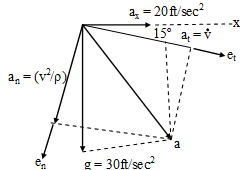
From the figure we get
a n = 30 cos 15º – 20 sin 15º = 23.8 ft/sec 2 a t = 30 sin 15º + 20 cos 15º = 27.1 ft/sec
2 We may now compute the radius of curvature from
[a n = v
2 / ρ ] ρ =  =
=
 = 13.01 (10 6 ) ft Ans.
The rate at which v is increasing is simply the t-component of acceleration.
[  = a t ]
  = 27.1 ft/sec 2 Ans.
The angular rate  of line GC depends on v and ρ and is given by
[v = ρ  ]
]  = v/ ρ =
  = 13.53(10 –4 ) rad/sec . Ans.
With unit vectors e n and e t for the n- and t-directions, respectively, the total acceleration becomes
a = 23.8e n + 27.1e t ft/sec 2 Ans.
Helpful Hints:
1. Alternatively we could find the resultant acceleration and then resolve it into n- and t-components.
2. To convert from mi/hr to ft/sec., multiply by  =
=  which is easily remembered, as 30 mi/hr is the same as 44 ft/sec.
Prepare Smarter with CGP Edu
Get practice questions, solutions, and test series in one place.
Write a Review
Share your experience with this question and solution.
Commentary
Send your comment, doubt, correction, or feedback to admin.
Similar Questions
Explore conceptually related problems